
At Datenna, our China experts continuously track and conduct detailed investigations into Chinese FDI in Europe and the US. This article elaborates on Chinese investments in the UK prior to the 2021 National Security and Investment Act coming into force.
Short Read
FDI Landscape Pre-2021 National Security and Investment Act
This short analysis conducted by Datenna provides a recap of the Chinese investments made between 2011 and 2022. It is worth noting that most of the FDI data predates the 2021 National Security and Investment Act — pivotal legislation that granted the UK government enhanced powers to scrutinise and intervene in business transactions to safeguard both business and national interests.
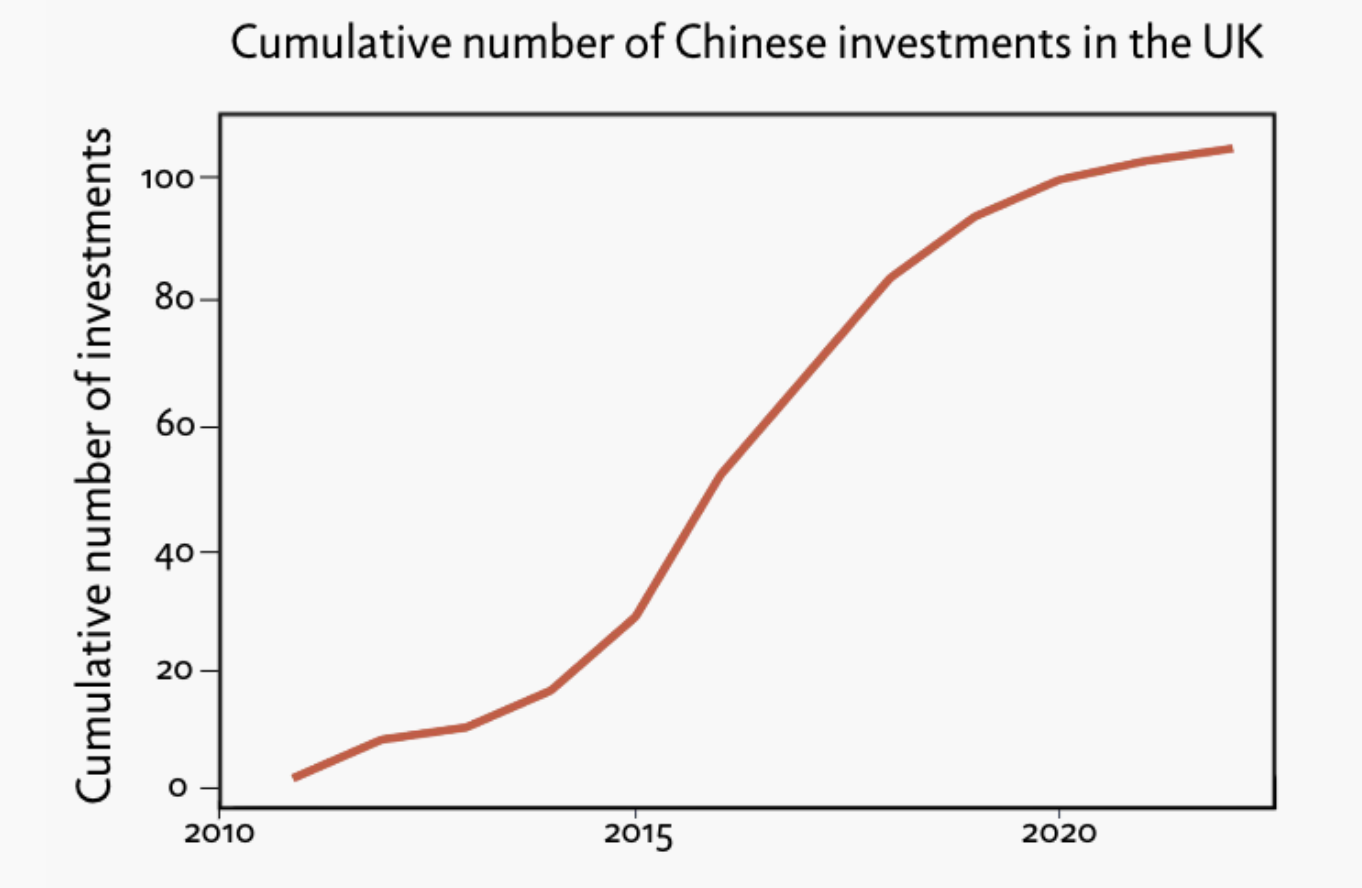
The FDI Timeline: 2011–2022
An analysis of over 100 enterprises reveals that the most significant surge of Chinese investment in the UK occurred between 2015 and 2019. This surge mirrors trends observed in other EU countries. The sectors that attracted the most Chinese investments include consumer products and services, entertainment, media and education, energy, financial services, and the automotive sector.

Investor Risk Levels and Sector-Specific Priorities
A deeper examination of these investments' ultimate beneficial ownership reveals a striking trend. In 47% of cases, Chinese investing companies showed a medium to high risk level of state influence — meaning that government entities directly or indirectly owned a significant portion of acquired shares, received state funding, or a combination of both.
More than half of the investments in specific sectors — including energy, infrastructure, machinery, aviation, logistics, agriculture and food, metals, and basic materials — came from medium and high-risk investors. This percentage surpasses the EU average of 40%, indicating that companies with a higher risk of state influence play a significant role in UK and EU investments.
Low-risk companies, less likely to be influenced by state objectives, favoured sectors such as consumer products and services, entertainment, media, education, financial services, automotive, and ICT. Investments by low-risk companies in consumer products and services included hospitality services such as hotels, clubs, restaurants, and supermarket chains.
High-risk Chinese investors were concentrated in the energy sector and transport and infrastructure. A closer examination revealed that many of these investments involved equity investments in wind farms, aligned with the UK-China strategic partnership on offshore wind energy.
Balancing Risks and Benefits
Contrary to common discourse, investments by Chinese companies at a higher risk of state influence do not necessarily outweigh the benefits. These high-risk companies, often state-owned enterprises, tend to be long-term investors. Additionally, lower-risk companies may lack the expertise or capacity to invest in certain industries, leading to a higher presence of high-risk companies in sectors like energy and infrastructure.
In conclusion, every investment in strategic assets carries its own set of risks and opportunities. Understanding the nuances of FDI is crucial. Datenna's data can assist governments in precisely assessing these variables, providing transparency and traceability when evaluating Chinese investors.